
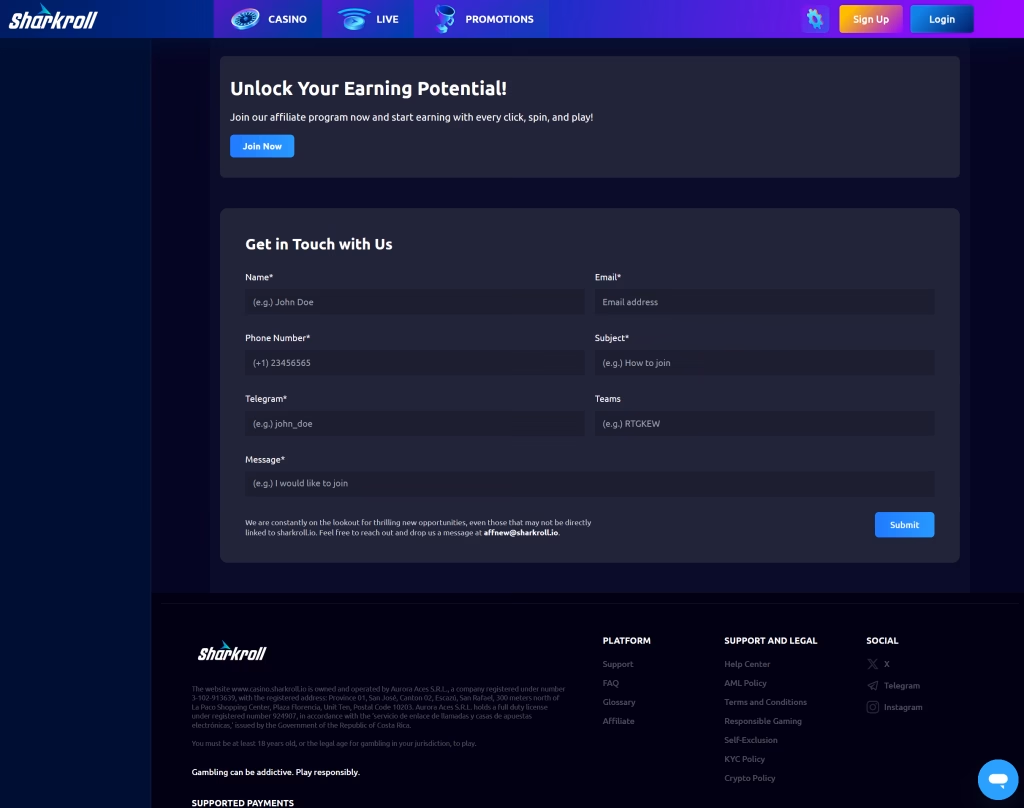
Sharkroll Affiliates
Updated: 11/12/2025
1. Executive Summary and Market Context
The contemporary online gambling industry is currently witnessing a tectonic shift toward decentralization, characterized by the rapid rise of “Crypto Casinos” that blend traditional betting mechanics with blockchain technology. In this hyper-competitive environment, affiliate programs serve as the lifeblood of operator growth, and for the professional affiliate, selecting the right partner is a decision that transcends mere commission percentages. It requires a holistic analysis of conversion funnels, player retention economics, and technical reliability.
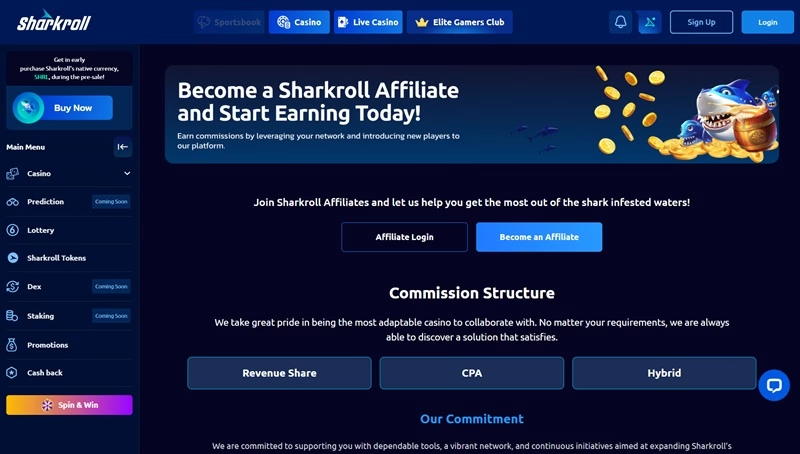
This report provides an exhaustive operational review of Sharkroll Affiliates, the official partnership program for Sharkroll Casino. Owned and operated by Aurora Aces S.R.L., this program represents a distinct archetype in the modern iGaming sector: a high-tech, crypto-forward operator looking to aggressively capture market share through a combination of unique product features—such as an integrated NFT exchange—and an exceptionally high revenue share ceiling.1
1.1 The Evolution of Crypto-Centric Affiliate Programs
To understand the specific value of Sharkroll Affiliates, one must place it within the broader historical context of iGaming affiliation. Historically, the industry was dominated by fiat-based casinos regulated by stringent bodies like the UKGC or MGA. These programs offered stability but were often plagued by slow bank wire payments, invasive KYC (Know Your Customer) protocols for affiliates, and declining player values due to deposit limits.
Sharkroll represents the counter-movement. By operating under a Costa Rica gaming license and prioritizing cryptocurrency transactions, it caters to a demographic of players and affiliates who value speed, anonymity, and higher transaction limits.1 For the affiliate, this translates to potentially higher Lifetime Value (LTV) per player, as crypto-gamblers are statistically shown to deposit larger amounts and play with higher frequency than their fiat counterparts.
1.2 Sharkroll’s Position in the 2024 iGaming Landscape
Sharkroll is not merely another “skin” of a white-label solution; it is positioning itself as a hybrid entertainment hub. The inclusion of a Sportsbook, Live Casino, Poker, and the novel NFT Exchange suggests a strategy aiming to retain players within the ecosystem by offering a “super-app” experience for gambling.1
For the affiliate marketer, this multi-vertical approach is critical. It mitigates the risk of player churn. If a player loses interest in slots, they might migrate to the sportsbook for the World Cup, or to the NFT exchange to speculate on digital assets. The affiliate retains the commission across all these activities, smoothing out the variance typically associated with single-vertical casinos.
1.3 Strategic Value Proposition for Affiliates
The headline metric for Sharkroll Affiliates is undoubtedly the Revenue Share, which ranges from a baseline of 20% up to a staggering 60%.1 In an industry where 45% is often considered the “gold standard,” offering 60% indicates a program in an aggressive acquisition phase, willing to sacrifice short-term operator margin to build a substantial player database.
However, high commissions are often accompanied by high risks. This report will meticulously dissect the terms and conditions, specifically focusing on the ambiguity surrounding Negative Carryover and the lack of API/Postback integration, to ensure that potential partners enter this relationship with their eyes wide open. The goal is to provide a roadmap for professional affiliates to extract maximum value from the Sharkroll program while navigating its technical and operational nuances.
2. Corporate Governance and Regulatory Framework
The foundation of any sustainable affiliate partnership is trust in the operator’s corporate structure and regulatory standing. While high commissions are attractive, they are meaningless if the operator is insolvent or legally compromised.
2.1 Ownership Structure: Aurora Aces S.R.L.
Sharkroll Affiliates is managed by Aurora Aces S.R.L..1 In the offshore gaming world, the corporate identity of the operator provides clues to their operational philosophy. S.R.L. (Sociedad de Responsabilidad Limitada) is a common corporate structure in Latin American jurisdictions, functioning similarly to an LLC in the United States.
The management by Aurora Aces S.R.L. implies a dedicated operational team rather than a massive, faceless conglomerate. The research indicates that the program prides itself on “dedicated account managers” and a “professional team of agents”.1 For affiliates, this is often preferable to dealing with massive PLCs (Public Limited Companies). Boutique operators are typically more agile, more willing to negotiate custom terms, and faster to resolve payment issues than larger, bureaucratic organizations.
2.2 Jurisdictional Analysis: The Costa Rica License
Sharkroll holds a gaming license granted by Costa Rica.1 It is imperative for affiliates to understand the nuances of this jurisdiction. Unlike the Malta Gaming Authority (MGA) or the UK Gambling Commission (UKGC), Costa Rica does not have a specific “gaming control board” that actively monitors RTP (Return to Player) or mediates player disputes in the same way. Instead, companies operate under a “Data Processing License” which allows for online gambling activities.
Implications for Affiliates:
-
Flexibility: Costa Rican operators have immense flexibility in the markets they accept and the cryptocurrencies they integrate. This allows Sharkroll to accept players from “grey markets” where MGA casinos cannot operate, significantly widening the Total Addressable Market (TAM) for affiliates.
-
Conversion Rates: Because the KYC requirements in Costa Rica are generally less frictionless than in Europe, conversion rates from “Registration to Deposit” are typically higher. Players face fewer hurdles when trying to fund their accounts.
-
Due Diligence: Because regulatory oversight is lighter, the burden of trust falls on the operator’s reputation. Affiliates must rely on the “Lifetime Partnership” promise and the transparency of the tracking software to ensure they are paid correctly.
2.3 Compliance and Excluded Territories
Despite the flexibility of the license, Sharkroll maintains a strict list of Excluded Countries to ensure compliance with global anti-money laundering (AML) standards and to respect the sovereignty of strict regulatory regimes.
The data explicitly states that Sharkroll Affiliates does not accept players from the following regions 1:
| Region | Specific Countries | Reason for Exclusion (Inferred) |
| North America | USA, US Virgin Islands | Strict Federal Regulations (UIGEA) |
| Middle East | Iran, Jordan, Lebanon, Qatar, Syria, UAE, Yemen | Religious/Legal Prohibitions & FATF High-Risk |
| Asia | Japan, North Korea (DPRK), Myanmar, Pakistan, Singapore | Regulatory Licensing & Sanctions |
| Europe | Poland, Russia, Kosovo | Local Licensing Requirements & Sanctions |
| Others | Libya, Somalia, Sudan, Trinidad and Tobago | Political Instability / AML Risk |
Strategic Takeaway: Affiliates must employ geo-targeting on their websites. If you have a global traffic source, you must set up a traffic filtration system (TDS – Traffic Distribution System) to route US or Russian traffic to alternative offers, ensuring that your Sharkroll conversion metrics remain healthy. Sending disqualified traffic not only wastes the affiliate’s bandwidth but can also annoy the affiliate manager, potentially harming negotiation leverage for higher commission tiers.
3. Brand Architecture: The Sharkroll Ecosystem
To successfully market a casino, an affiliate must understand the product’s “hook.” Why would a player choose Sharkroll over thousands of competitors? The answer lies in its brand architecture, which blends traditional gaming with Web3 innovation.
 3.1 The Convergence of Web3 and Traditional Gambling
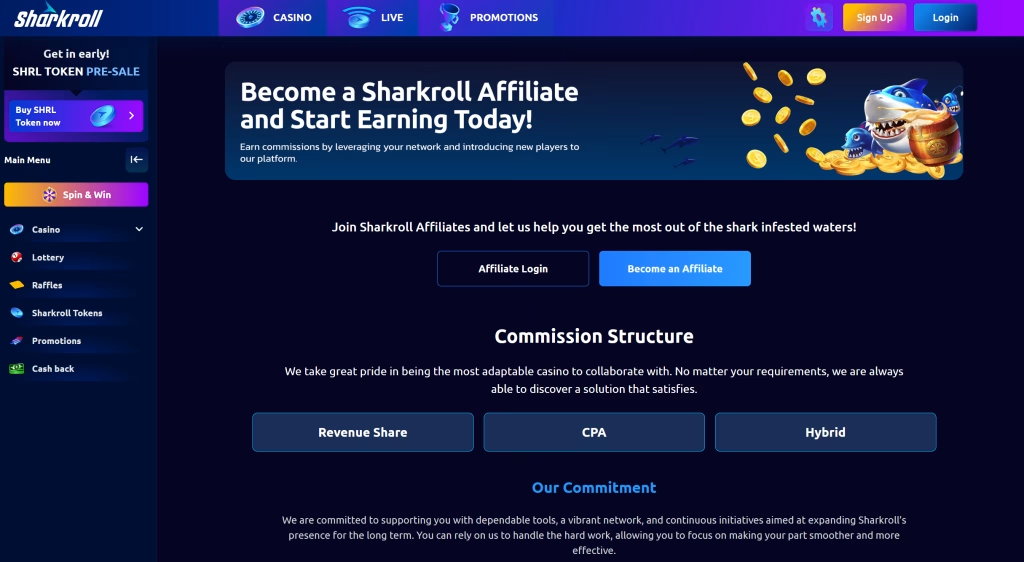
The term “GambleFi” refers to the intersection of decentralized finance and gambling. Sharkroll is positioning itself squarely in this niche. By offering an environment where players can use cryptocurrencies not just for betting chips, but potentially for buying the “coin of the casino” via an NFT exchange 1, Sharkroll is gamifying the bankroll itself.
This suggests that the Sharkroll platform is built on a high-tech stack capable of handling blockchain interactions. For the affiliate, this is a powerful narrative. Marketing copy can pivot away from “Win Big” (which is high variance) to “Join the Ecosystem” (which implies community and longevity).
3.2 Product Vertical Analysis: Casino, Live Dealer, and Poker
The core of the revenue generation engine is the casino product. Sharkroll aggregates content from top-tier studios, including Tada Gaming, Summus Games, and ela Games.1
-
Slots: The presence of these studios ensures a steady stream of high-volatility video slots. These are the primary drivers of Gross Gaming Revenue (GGR). Slots have the highest house edge and the fastest game loops, making them the most profitable category for affiliates on a revenue share model.
-
Live Dealer: The report notes the inclusion of “many live dealer games like poker, blackjack, baccarat, roulette”.1 Live Casino is the fastest-growing vertical in iGaming. It appeals to a skeptical demographic that trusts a physical dealer over a random number generator (RNG). By offering a robust live suite, Sharkroll increases player retention/stickiness.
-
Poker: The mention of poker is significant. Poker players are distinct from casino players; they are more strategic and have longer session times. While the “rake” in poker generates less immediate revenue than slots, poker players are notoriously loyal.
3.3 The Sportsbook Advantage: Cross-Selling and Retention
Sharkroll is not just a casino; it is a sportsbook. The data highlights a wide array of betting markets: Football, Tennis, Volleyball, Basketball, Baseball, American Football, Handball, Golf, Rugby, and more.1
The Cross-Sell Mechanism:
A typical user journey involves a player signing up to bet on the Super Bowl or the Champions League. Once the game ends, the player has a balance in their account. If the platform is purely a sportsbook, they might withdraw. However, Sharkroll’s integrated ecosystem encourages that player to take their winnings to the Live Blackjack table or the Slot library.
For the affiliate, this “wallet liquidity” across verticals is crucial. It means you can acquire a customer using cheap sports traffic (low CPC) and monetize them like a casino player (high LTV). This arbitrage is one of the most effective strategies in iGaming affiliate marketing.
3.4 The NFT Exchange: A Unique Retention Mechanism
Perhaps the most distinct feature identified in the research is the NFT Exchange where players can “buy the coin of the casino and others”.1 This moves Sharkroll into the realm of “Social-Fi.”
If players hold an NFT or a specific casino token, they are financially and psychologically invested in the platform’s success. They are less likely to churn to a competitor because leaving Sharkroll would mean decoupling from their digital assets. This creates a “moat” around the player base. Affiliates should highlight this feature to attract crypto-natives who are bored with standard Web2 casinos.
4. Technical Infrastructure and Tracking Integrity
In the digital marketing world, data is currency. The reliability of the tracking software dictates whether an affiliate gets paid for their hard work.
4.1 The MAP (Marketing Affiliate Partners) Platform
Sharkroll utilizes the MAP software.1 MAP is a recognized third-party affiliate management platform. The choice of MAP over a proprietary (in-house) build is a positive signal.
Why MAP Matters:
-
Independence: Proprietary platforms are often “black boxes” where the operator can manipulate data. MAP is a neutral third-party vendor. They have no incentive to “shave” (under-report) affiliate leads.
-
Stability: MAP is built to handle massive traffic spikes. If an affiliate sends viral traffic during a major sporting event, the server infrastructure of MAP is less likely to crash than a custom-built script.
-
Familiarity: Many professional affiliates are already accustomed to the MAP interface, reducing the learning curve.
4.2 Attribution Accuracy and Reporting Granularity
The research indicates that the program supports Dynamic Variables.1 This is a critical feature for optimization.
-
Scenario: An affiliate runs three different campaigns: one on Google Ads, one on a Telegram channel, and one via an email newsletter.
-
Function: With dynamic variables, the affiliate can append tags (e.g.,
?subid=telegram_promo) to their tracking links. -
Outcome: The MAP dashboard will separate the data, allowing the affiliate to see that Telegram generates high registrations but low deposits, while Email generates low registrations but high deposits. This granular data allows for Return on Ad Spend (ROAS) optimization.
4.3 The Media Buyer’s Dilemma: API and Postback Limitations
A significant finding in the research is the technical limitation regarding automation. The data states:
-
Supports API: No 1
-
Postbacks: No 1
-
Real-time Stats: No 1
This is a major friction point for a specific subset of affiliates: Media Buyers.
Modern media buying relies on “Postbacks” (Server-to-Server / S2S pixels). When a player deposits, the casino server sends a signal back to the ad network (e.g., Google Ads or PropellerAds) to “train” the algorithm to find more depositors.
Without S2S postbacks, media buyers are flying blind. They cannot use auto-optimization tools.
-
Strategic Workaround: Affiliates relying on paid traffic must rely on “manual uploads” of conversion data back to their ad networks or negotiate with the Sharkroll team to implement a hard-coded pixel for large campaigns. For SEO affiliates (content sites), this limitation is negligible, but for PPC experts, it is a significant hurdle that must be addressed during the onboarding negotiation.
5. Commercial Economics: Revenue Share and Profitability
The core of the Sharkroll value proposition is its aggressive commercial terms.
5.1 Analyzing the 20% to 60% Revenue Share Spectrum
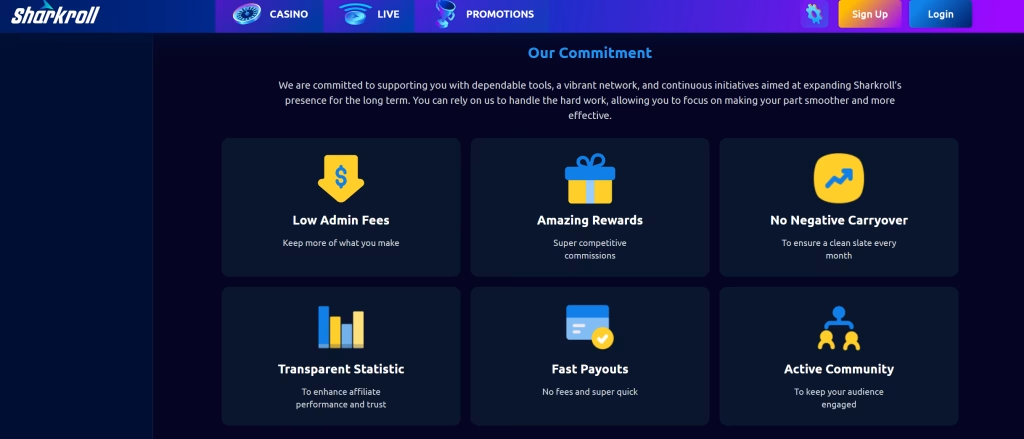
The program advertises a commission structure of 20% – 60%.1
To put this in perspective:
-
Industry Average: 25% – 45%.
-
Sharkroll Ceiling: 60%.
This 60% tier is an anomaly. It suggests that Sharkroll is operating with very thin margins on top-tier affiliates in exchange for volume.
-
The Calculation: If a player loses $1,000, and the affiliate is on 60%, the affiliate gets $600. The operator keeps $400. Out of that $400, the operator must pay game provider fees (approx. 15%), payment processing fees (approx. 5%), and operational costs. This leaves the operator with very little profit.
-
Inference: The 60% tier is likely reserved for “Whales” or super-affiliates delivering massive volumes of First Time Depositors (FTDs). The entry-level affiliate will likely start at 20% or 25%.
5.2 The Economics of High-Tier Commissions
The research explicitly states that “Sharkroll Affiliates does not define a primary commission structure to the public” and advises partners to “contact their support team and negotiate”.1
The Negotiation Playbook:
Affiliates should never accept the default 20%. The presence of a 60% ceiling proves the budget exists.
-
Prepare Data: Approach the account manager with screenshots of earnings from other programs.
-
Ask for a Ladder: Propose a tier structure. E.g., “If I bring 0-10 players, pay me 35%. If I bring 11-30, pay me 45%. If I bring 50+, pay me 55%.”
-
Leverage the Brand Newness: Since the brand is not yet popular 1, conversion might be lower. Use this as leverage to demand a higher fixed percentage to offset the risk of promoting an unknown brand.
5.3 CPA and Hybrid Deal Structures
While Revenue Share is the standard, the data confirms that CPA (Cost Per Acquisition) and Hybrid deals are available upon request.1
-
CPA: Useful for cash flow. You get a one-time fee (e.g., $150) per player.
-
Hybrid: The best of both worlds. E.g., $50 CPA + 30% Rev Share. This covers your ad costs immediately while keeping you invested in the long-term upside.
Given the crypto nature of the casino (high volatility), a Hybrid deal is the safest commercial structure. It protects against months where players win (negative revenue) while ensuring the affiliate covers their content creation costs.
5.4 Sub-Affiliation: Leveraging Network Effects
Sharkroll supports a Sub-affiliate program.1 This allows marketers to recruit other affiliates.
-
Strategy: If you are an influencer in the “Make Money Online” niche, you can create a tutorial on “How to become a Casino Affiliate” and link to Sharkroll using your sub-affiliate link. You will earn a master commission (typically 2-5%) on everything your sub-affiliates earn. This creates a passive income stream distinct from player activity.
6. Terms of Engagement: Contractual Risk Assessment
The most dangerous part of an affiliate agreement is what is buried in the Terms & Conditions.
6.1 The Negative Carryover Ambiguity
There is a critical contradiction in the available intelligence regarding Negative Carryover (NCO).
-
Snippet Body: “Sharkroll Affiliates could carry over negative balances… but this policy could also be negotiated”.1
-
Snippet Table: “Negative Carryover: No”.1
The Risk:
Negative Carryover occurs when a player wins big. If a referred player wins $50,000, the affiliate account goes into negative -$50,000. If NCO is active, the affiliate earns $0 until that $50,000 hole is dug out by other players. This can take months or years.
The Solution:
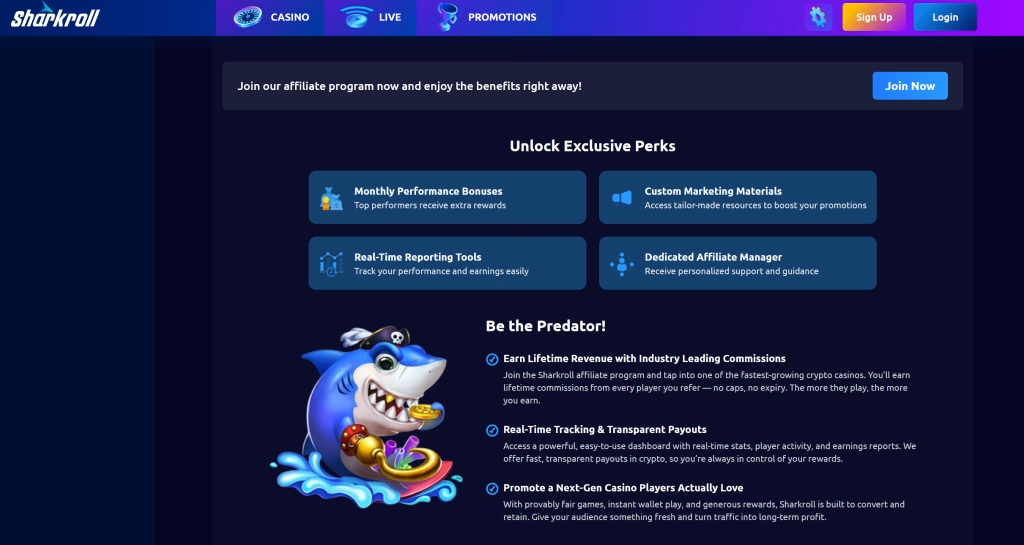
Because the text suggests NCO could apply, affiliates must assume it does unless told otherwise. Negotiation Point #1 must be the removal of Negative Carryover. The table suggesting “No” might apply to specific promotional periods or tiers, but the contract is what matters. Ensure the IO (Insertion Order) explicitly states “No Negative Carryover.”
 6.2 Lifetime Partnership vs. Activity Quotas
The report highlights a “Lifetime partnership” as a pro.1
-
Context: Some predatory programs have “Minimum Activity Quotas.” If an affiliate stops sending new players for 3 months, the program stops paying them for their old players.
-
Sharkroll’s Stance: The “Lifetime” clause implies that Sharkroll does not have this predatory clause. If you refer a player in 2024, and they are still playing in 2030, you should still receive your 60% commission, even if you haven’t sent a new player in years. This makes the program an excellent vehicle for building a retirement asset.
6.3 Admin Fees and Hidden Costs
While not explicitly detailed in the snippet beyond “Admin Fee: -“, standard industry practice involves an Admin Fee deducted from GGR before RevShare is calculated. This usually covers game provider royalties and taxes.
-
Inference: Affiliates should ask: “Is the Rev Share calculated on GGR or NGR?” and “What is the Admin Fee percentage?” A standard fee is 20-25%. If Sharkroll charges no admin fee, the 60% RevShare is even more valuable. If they charge a 40% admin fee, the effective RevShare is significantly lower.
7. Financial Operations and Payment Logistics
Getting paid is the final and most important step.
7.1 Cryptocurrency Settlements: Speed and Efficiency
Sharkroll processes payments via Bitcoin and other cryptocurrencies.1
-
Speed: Crypto transactions are settled on the blockchain, bypassing the SWIFT network’s 3-5 day delays.
-
Privacy: For affiliates operating in jurisdictions where banking relationships with gambling companies are scrutinized, receiving payments in BTC provides a layer of financial privacy and autonomy.
7.2 Minimum Thresholds and Cash Flow Management
A major advantage identified is that Sharkroll “does not define a minimum threshold”.1
-
Competitor Comparison: Many programs require an affiliate to earn at least €500 or €1000 before they release a wire transfer. This hurts small affiliates.
-
Sharkroll Advantage: If an affiliate earns $50, they get paid $50. This micro-payment capability is likely enabled by the low transaction costs of certain blockchains (or batching BTC transactions). It democratizes access for new affiliates who are just starting to build traffic.
8. Traffic Acquisition and Marketing Strategy
Having analyzed the product and the terms, how does one actually market Sharkroll?
8.1 Geographic Targeting: The Canadian Opportunity
Canada is highlighted as a “Featured Country”.1
-
The Landscape: Canada is a mature market with high player values. While Ontario has regulated, the rest of Canada remains a “grey” market accessible to offshore operators like Sharkroll.
-
Strategy: Create content tailored to Canadian banking preferences (even though Sharkroll is crypto-focused, Canadians are tech-savvy). Use local vernacular (“loonie,” “parlay”) and cover sports popular in Canada (NHL, NBA).
8.2 SEO Strategy for “GambleFi” Keywords
Because Sharkroll is not a household name, bidding on “Sharkroll Review” will have low volume. The opportunity lies in Long-Tail Keywords related to its USP.
-
Keywords: “Casino with NFT exchange,” “Buy casino coin,” “High limit crypto sportsbook,” “No KYC casino Canada.”
-
Content Plan: Write deep-dive guides on how to use the NFT exchange. Explain the tokenomics. These articles will attract high-intent users who are looking for exactly the features Sharkroll offers.
8.3 Leveraging Social Proof and Community Channels
Sharkroll is active on Telegram (https://t.me/sharkroll) and Discord.1
-
Affiliate Tactics: Modern crypto-gamblers live on Telegram and Discord. Affiliates should not just rely on SEO websites. Creating a Telegram “Prediction Channel” for sports picks and pinning the Sharkroll affiliate link is a highly effective strategy. The presence of the brand on these platforms adds legitimacy to the affiliate’s recommendation.
9. SWOT Analysis
| Strengths (Internal) | Weaknesses (Internal) |
|
Revenue Share: Massive potential up to 60%.
Product: Hybrid Casino + Sports + NFT Exchange.
Payments: No minimum threshold, fast Crypto payouts.
Lifetime Value: No de-tagging of players. |
Tech Stack: No API, No Postbacks, No Real-time stats.
Brand Equity: New brand, low trust compared to giants.
Transparency: Commission tiers are hidden/negotiable. |
| Opportunities (External) | Threats (External) |
|
Crypto Adoption: Growing market of crypto-native gamblers.
Niche Domination: “GambleFi” is an unsaturated keyword vertical.
Canada: High-value market targeting. |
Regulation: Costa Rica license offers low protection against global regulatory crackdowns.
Volatility: Crypto market crashes can devalue affiliate earnings.
Ambiguity: NCO policy needs clarification. |
10. Conclusion and Final Recommendations
Sharkroll Affiliates presents a compelling, albeit complex, opportunity for the modern iGaming marketer. It is not a “set it and forget it” program for beginners. It is a high-performance vehicle designed for affiliates who understand negotiation, crypto-economics, and niche marketing.
The 60% Revenue Share potential is the crown jewel, but it is guarded by the necessity of negotiation. The NFT Exchange provides a unique marketing angle that separates it from thousands of generic white-label casinos. However, the technical limitations regarding postbacks make it a challenging environment for pure media buyers.
Final Verdict:
For SEO Affiliates and Community Managers (Telegram/Discord) focusing on the crypto-gambling niche, Sharkroll is a Strong Buy. The product fits the audience, and the revenue ceiling is incredibly high.
For PPC/Media Buyers, the program is a Hold until a pixel tracking solution is negotiated or the platform upgrades its tech stack.
Actionable Steps for New Partners:
-
Contact Support immediately upon registration. Do not run traffic on the default settings.
-
Negotiate the removal of Negative Carryover in writing.
-
Request a Hybrid Deal to mitigate the volatility of a new brand.
-
Build content around the “Web3/NFT” aspect of the casino to capture high-intent, tech-savvy traffic.
Click here for Casinos Broker – Sharkroll Casino Review
 11. Frequently Asked Questions (FAQ)
Q1: What is the maximum revenue share I can earn with Sharkroll Affiliates?
Sharkroll Affiliates offers a tiered revenue share model that peaks at 60%.1 However, this top tier is typically reserved for high-performing affiliates. New partners usually start at a lower percentage (around 20-30%) and must negotiate their way up based on the quality and volume of traffic delivered.
Q2: Does the program carry over negative balances?
The policy regarding negative carryover is ambiguous in the documentation. While some data points suggest “No Negative Carryover,” the text explicitly states that negative balances could be carried over.1 It is critical that you negotiate a “No Negative Carryover” clause with your account manager before sending traffic to ensure your future earnings are protected.
Q3: How often are payments processed, and is there a minimum threshold?
Commissions are paid once per month. A significant advantage of Sharkroll is that there is no minimum payment threshold.1 Payments are primarily processed via Bitcoin and other cryptocurrencies, ensuring fast and borderless transactions.
Q4: Can I use API or Postbacks for tracking?
Currently, the Sharkroll program, powered by MAP, does not support API or Postback (S2S) tracking.1 This limits the ability to use third-party automated optimization tools. Affiliates relying on paid media should discuss manual pixel implementation or alternative tracking methods with the support team.
Q5: Which countries are excluded from promoting Sharkroll?
Sharkroll does not accept players from the USA, Russia, Poland, UAE, Singapore, Iran, North Korea, and several other jurisdictions.1 Always check the most current Terms & Conditions for the full list of restricted territories to avoid wasting traffic.
Q6: What makes Sharkroll Casino unique compared to other brands?
Sharkroll distinguishes itself through the integration of Web3 features, specifically an NFT Exchange where players can buy and trade the casino’s native coin.1 Additionally, it offers a complete “one-stop” experience with a Sportsbook, Live Casino, and Poker vertical all under one account.
Q7: Is there a sub-affiliate program available?
Yes, Sharkroll offers a sub-affiliate scheme.1 While the specific commission percentages for sub-affiliates are not public, you can request a unique referral link from your account manager to earn commissions on other affiliates you introduce to the program.
Get new deals before they go public
New casino, sportsbook and affiliate listings go to subscribers 48h before we list them publicly. One email a week at most.
Prefer Telegram? Join iGaming professionals on @igamingdealflow