
The Most Expensive Casino Acquisitions in History
The history of casino M&A is a record of consolidation, regulatory arbitrage, and strategic bets on the future of gambling. From the land-based mega-mergers of the 1990s through to the digital transformation deals of the 2020s, the largest transactions in casino history reflect the industry’s dominant dynamics at the time of each deal — and the strategic logic that justified paying billions for a collection of licences, brands, and player relationships.
This article covers the most significant casino and iGaming acquisitions ever completed — the headline figures, the strategic rationale behind each deal, and what each transaction reveals about how sophisticated buyers think about the value of gambling assets. For buyers and investors operating in the current mid-market, understanding these landmark deals provides essential context for evaluating how the market prices regulatory access, brand equity, and market share in the sector.
Land-Based Consolidation: Setting the Template
The M&A logic that governs iGaming transactions today was largely developed in the land-based casino consolidation wave of the 1990s and 2000s. The drivers were the same as in digital: regulatory access to gaming licences that could not be replicated organically, economies of scale in marketing and operations, and the ability to command premium slot allocations and software terms through sheer negotiating scale.
The landmark land-based deals established several M&A principles that persist in online casino transactions: that licences and brands command premium multiples over their financial fundamentals, that integration risk in casino M&A is significant and must be priced in, and that the regulatory environment at the time of a deal can dramatically affect whether the strategic thesis plays out as expected.
MGM Resorts – Mandalay Resort Group Merger (2005) — $7.9B
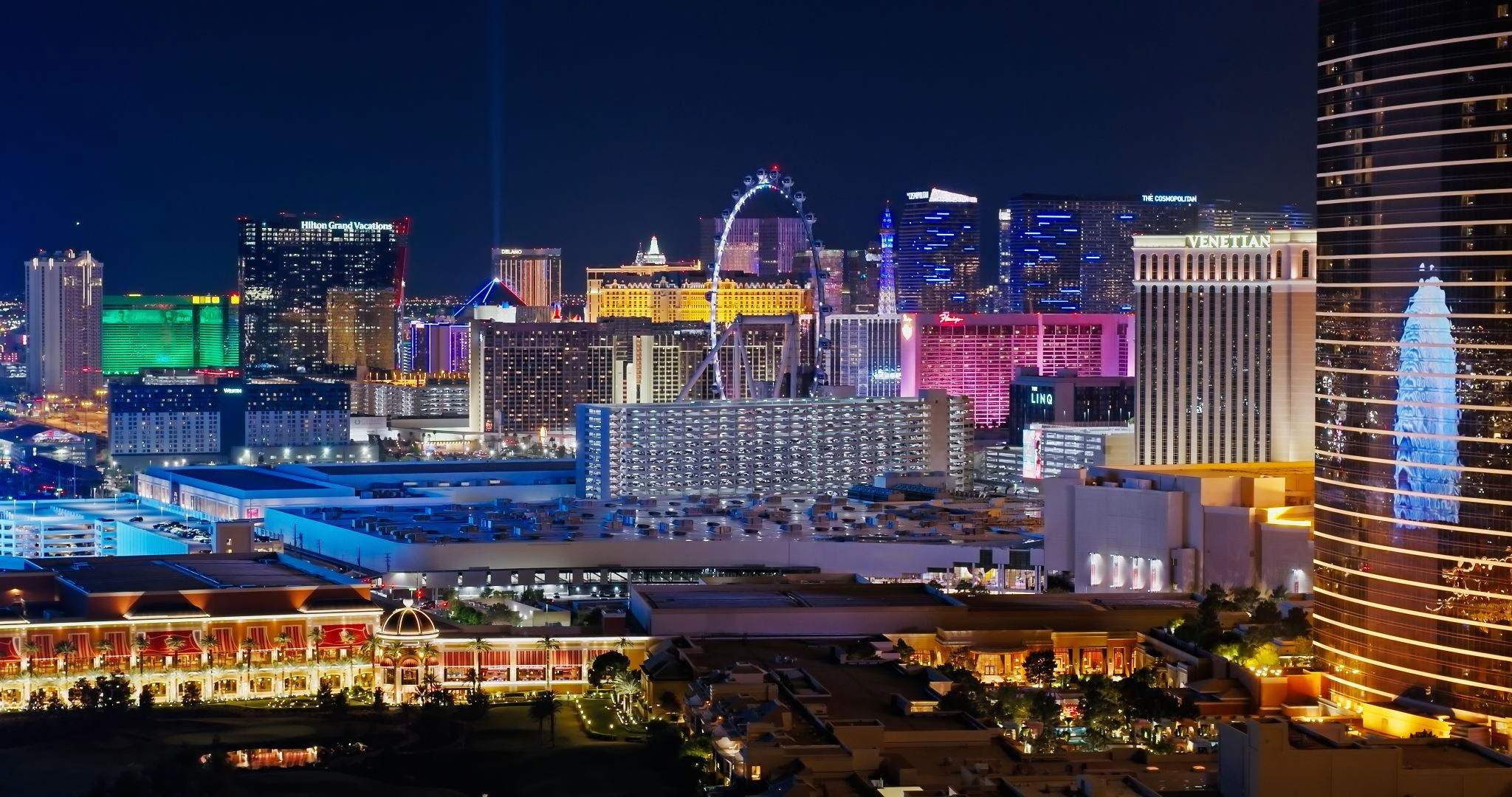
MGM’s acquisition of Mandalay Resort Group in 2005 for $7.9 billion created the largest gaming company in the world at the time, giving MGM control of the Mandalay Bay, Monte Carlo, and Luxor properties alongside its existing Las Vegas portfolio. The deal was structured as a merger in which MGM assumed $2.5 billion of Mandalay’s debt, making the total enterprise value consideration one of the largest in gaming history at that point.
The strategic logic was straightforwardly consolidationist: Las Vegas Strip real estate and gaming licences are finite, and acquiring them through M&A is structurally more efficient than greenfield development. By combining operations, MGM could rationalise corporate overhead, leverage combined purchasing scale with suppliers and entertainers, and present a unified loyalty programme across a portfolio that covered multiple market segments.
The deal also reflected a specific moment in Las Vegas’s evolution — the mid-2000s boom years before the 2008 financial crisis — when land-based casino valuations were at historic highs. MGM paid a premium that proved difficult to sustain when the recession hit, ultimately contributing to the financial pressures that led MGM to pursue its own restructuring in subsequent years.
Caesars Entertainment – Harrah’s Acquisition (2005) — $9B
In the same year as the MGM-Mandalay deal, Harrah’s Entertainment acquired Caesars Entertainment for approximately $9 billion, combining two of the most recognisable brands in American gambling. The acquisition created a company that operated more than 50 casinos across the United States under brands including Caesars, Harrah’s, Paris Las Vegas, Bally’s, and Horseshoe.
The strategic rationale centred on the Total Rewards loyalty programme — Harrah’s had built what was then the most sophisticated player loyalty infrastructure in land-based gaming, and the acquisition of Caesars’ premium Las Vegas footprint gave the combined company the properties needed to make the loyalty programme a genuine competitive differentiator at the luxury end of the market.
The Harrah’s-Caesars transaction also foreshadowed a recurring theme in large casino M&A: the role of financial engineering. The deal was followed by the $30 billion leveraged buyout of Harrah’s itself in 2008 by Apollo Global Management and TPG Capital, which loaded the company with debt that ultimately forced it into bankruptcy in 2015. The subsequent restructuring and re-emergence as the modern Caesars Entertainment — and its eventual acquisition by Eldorado Resorts in 2020 for $17.3 billion — created one of the most complex multi-decade M&A sagas in gaming history.
The Digital Pivot: Online Casino M&A
The shift from land-based to online casino M&A has been the defining trend of the last decade. As online gambling markets have regulated across Europe, North America, and increasingly Latin America, the premium for digital iGaming assets has approached and in some cases exceeded the multiples commanded by land-based properties at their peak.
Several structural factors drive this. Online casinos operate at significantly higher margins than land-based properties once the infrastructure is in place. They are not constrained by physical capacity — a digital casino can serve an unlimited number of players simultaneously without incremental capital expenditure. And the regulatory dynamic has shifted: a gaming licence that took 18 months to obtain in 2018 is now the gateway to a multi-billion dollar addressable market, justifying premium acquisition prices for the rights to operate legally in those markets.
Flutter Entertainment – The Stars Group (2020) — $11.2B
Flutter Entertainment’s all-share acquisition of The Stars Group in 2020 for $11.2 billion created the largest online sports betting and gaming company in the world by revenue. The combined group brought together Flutter’s European operations (Paddy Power Betfair, Betfair Exchange, Tombola) with The Stars Group’s global poker and casino brands (PokerStars, Full Tilt, BetStars, Sky Betting and Gaming) and its nascent US sports betting footprint through FOX Bet.
The strategic logic was scale-driven at multiple levels: combined revenue of over $4 billion provided the capital base to compete in the US market — then opening state-by-state — at the investment levels required to establish market share. The deal also resolved a long-running patent dispute between the two companies and eliminated a potential competitive threat in markets where both were operating. The combined FanDuel and PokerStars assets gave Flutter a dominant position in two of the most lucrative segments of online gambling globally.
The transaction also marked a significant moment in the institutionalisation of iGaming M&A. The all-share structure, the London Stock Exchange listing, and the subsequent dual-listing on the New York Stock Exchange demonstrated that iGaming companies could access the full spectrum of institutional capital markets — a maturation of the sector’s financial credibility that has made subsequent large transactions easier to execute.
Entain – Ladbrokes Coral (2016) — £2.9B
GVC Holdings’ acquisition of Ladbrokes Coral in 2018 (completing a process that began with the 2016 Ladbrokes-Coral merger) for £3.2 billion combined one of the UK’s oldest bookmaking brands with the digital capabilities GVC had developed through its European online casino and sports betting operations. The combined entity, rebranded as Entain in 2020, became one of the two dominant players in UK regulated online gambling alongside Flutter.
The deal was strategically significant for several reasons. It demonstrated that digital operators with strong technology and data capabilities could create substantial value by acquiring traditional land-based brands with large customer databases but underdeveloped digital infrastructure. GVC’s betting exchange technology, CRM sophistication, and international online casino operations were applied to Ladbrokes Coral’s 3,500 betting shops and 14 million registered players, creating a digital-physical hybrid that neither could have built independently.
The Entain story also illustrates the attraction of UK-licensed operators to international acquirers. MGM Resorts made a £8.1 billion acquisition approach for Entain in January 2021 — seeking a UKGC-licensed digital partner for its US expansion ambitions — which Entain’s board rejected as undervaluing the company. The episode confirmed that UKGC-licensed operators with genuine digital capabilities command premium valuations that strategic acquirers with US ambitions are willing to pay.
DraftKings – Golden Nugget Online Gaming (2022) — $1.56B
DraftKings’ acquisition of Golden Nugget Online Gaming for $1.56 billion in an all-stock transaction in 2022 was primarily a customer acquisition and regulatory access deal. Golden Nugget Online Gaming had developed a loyal player base in New Jersey and Michigan — two of the most established US regulated online casino markets — with a distinctive brand positioning at the premium end of the market.
For DraftKings, the acquisition served multiple purposes: it added a significant customer database in states where DraftKings was already operating (with associated cross-selling opportunities), provided the Golden Nugget brand as a distinct market positioning option at the premium segment, and delivered iGaming licences in states where DraftKings needed to strengthen its position ahead of anticipated further US market opening.
The deal also reflected the premium that US online casino licences command in the current regulatory environment. Online casino gaming in the US remains legal only in a small number of states — New Jersey, Michigan, Pennsylvania, Connecticut, West Virginia, and a handful of others — and the number of new licences granted in each state is limited. Acquiring an operator with an established presence and existing licence relationships is structurally more efficient than waiting for new licence allocations.
MGM Resorts – LeoVegas (2022) — $607M
MGM Resorts International’s acquisition of LeoVegas, the Swedish online casino operator, for $607 million in 2022 was one of the most strategically instructive deals in recent iGaming M&A history. MGM — a land-based gaming giant with $13 billion in annual revenue — paid a significant premium for a Swedish online casino company to acquire digital capability, a European regulatory footprint, and a proprietary mobile gaming technology stack that would underpin MGM’s BetMGM joint venture’s international expansion.
The deal valued LeoVegas at approximately 2x revenue — a premium that reflected the strategic value of the asset to a specific buyer rather than a market-clearing price for iGaming assets generally. MGM could not have built LeoVegas’s mobile technology, European licence portfolio, and 7+ million registered player base in the time it would take to reach MGM’s international growth targets. The acquisition was a technology and regulatory access purchase as much as a revenue acquisition.
LeoVegas also illustrates the premium commanded by mobile-first operators with genuine technology differentiation. The company had built one of the most highly rated mobile casino experiences in Europe over a decade, attracting a player base with above-average mobile engagement and LTV. This technology premium — the ability to build something genuinely better than the market standard in mobile UX — is one of the clearest drivers of premium valuations in digital iGaming M&A.
888 Holdings – William Hill International (2022) — £2.2B
888 Holdings’ acquisition of William Hill’s non-US international operations from Caesars Entertainment for £2.2 billion in 2022 was one of the most complex and consequential mid-market iGaming transactions of recent years. Caesars had acquired William Hill in full for £2.9 billion in 2021 primarily to access William Hill’s US sports betting business — and then sold the international operations (excluding the US) to 888, retaining the US business under the William Hill brand.
For 888, the acquisition represented a transformational scale-up: the combined group became one of the top three UK-regulated online gambling operators, with brands including 888casino, 888sport, William Hill, Mr Green, and SI Sportsbook. The UKGC-licensed William Hill brand, with its 150-year heritage and multi-million player database, was the cornerstone strategic rationale.
The transaction also demonstrated the risks of large acquisitions in iGaming. 888 faced significant post-acquisition integration challenges, regulatory headwinds from the UKGC’s increasingly demanding compliance requirements, and a period of financial pressure as the combined group’s leverage was higher than originally projected. The story is a reminder that iGaming M&A value creation depends on execution as much as on the strategic logic at the time of signing.
What These Deals Tell Us About Casino M&A Today
Several consistent themes emerge from the landmark casino acquisitions of the last two decades that have direct relevance for buyers and investors operating in the current mid-market.
Regulatory access commands a premium that is not captured in financial multiples alone. Every major deal in this list was driven at least partly by the acquirer’s desire to access a market or licence that it could not obtain efficiently through organic growth. The strategic premium for regulated iGaming assets — UKGC, MGA, US state licences — reflects the genuine difficulty of obtaining these permissions independently and the commercial value of the markets they unlock.
Technology differentiation is real and priced. LeoVegas and the Stars Group both commanded premiums that reflected their technology capabilities — mobile UX superiority and poker platform dominance respectively — not just their revenue. Buyers in the current market should evaluate technology quality as a distinct value driver, not just as a cost centre.
Integration risk is consistently underestimated. The post-acquisition challenges faced by Caesars (leveraged buyout debt), 888 (William Hill integration), and others in this list demonstrate that the strategic logic of an iGaming acquisition is necessary but not sufficient for value creation. Execution capability — particularly in the demanding compliance environment of today’s regulated markets — is as important as the deal terms.
| CasinosBroker.com — Access premium iGaming acquisition opportunities with expert M&A advisory. casinosbroker.com |
Frequently Asked Questions
Q: What was the largest online casino acquisition ever completed?
By enterprise value, Flutter Entertainment’s $11.2 billion all-share acquisition of The Stars Group in 2020 is the largest pure online gambling M&A transaction ever completed. If land-based casino acquisitions are included, the Eldorado Resorts acquisition of the post-bankruptcy Caesars Entertainment in 2020 for $17.3 billion is the largest gaming transaction in history, though it was primarily land-based with significant online components.
Q: Why did MGM pay such a premium for LeoVegas?
MGM paid approximately 2x revenue for LeoVegas — above the prevailing market multiple for comparable online casino operators at the time — because the acquisition gave MGM specific strategic assets it could not replicate quickly: a proven mobile gaming technology platform, a European regulatory footprint across MGA, UKGC, and Swedish markets, and a management team with deep European online gambling expertise. The strategic premium reflected the value of these assets to MGM specifically, not a general market re-rating of iGaming assets.
Q: What is the typical EBITDA multiple for a mid-market iGaming acquisition today?
Mid-market iGaming operator acquisitions (€5M–€30M EBITDA) in regulated markets currently trade at 5x–9x EBITDA depending on licence jurisdiction, revenue quality, and growth profile. This is below the multiples paid in the landmark transactions profiled above, which benefited from strategic premiums paid by specific acquirers with strong rationale for the specific asset. Mid-market buyers without a specific strategic premium rationale should underwrite to a 5x–7x EBITDA range for quality regulated assets.
Q: Is the US online casino market the biggest opportunity in iGaming M&A today?
The US market represents the largest single geographical expansion opportunity in online gambling globally, given its size, the pace of state-by-state regulation, and the established consumer sports betting behaviour that creates a natural pathway to casino adoption. However, the US market is already attracting significant institutional capital and the acquisition premiums for US-facing assets reflect this competition. For buyers without existing US presence, the entry cost is high. European regulated markets offer more accessible entry points with lower competition for quality mid-market assets.
Q: How do land-based casino valuations compare to online casino valuations?
Land-based casino valuations are primarily driven by real estate value (particularly in Las Vegas and Macau), gaming licence scarcity, and hotel/entertainment revenue diversification. Online casino valuations are driven by player database quality, recurring NGR, technology infrastructure, and regulatory licence portfolio. The two asset classes use different valuation methodologies — EV/EBITDA and EV/GGR are common for online; EBITDA multiples combined with real estate cap rate analysis are standard for land-based. The highest-value transactions typically involve assets with both physical and digital components.
Q: Why did Caesars sell William Hill International so quickly after acquiring it?
Caesars acquired William Hill in 2021 primarily for the US sports betting business — William Hill was one of the most established US retail sports betting operators with state licences across Nevada, New Jersey, and other markets. The international operations were not strategically aligned with Caesars’ core US land-based and digital strategy. Selling the international business to 888 allowed Caesars to recoup a significant portion of the acquisition cost while retaining the asset it actually wanted — the US sports betting business, which it subsequently rebranded under the Caesars Sportsbook name.
Q: What was the strategic rationale for the Flutter-Stars Group merger?
The merger combined Flutter’s European sportsbook strength (Paddy Power Betfair) with The Stars Group’s global poker dominance (PokerStars) and its growing US presence (FOX Bet). The combined scale gave the merged group the capital to invest aggressively in the US market — which both companies had identified as the most important growth opportunity in global online gambling — and resolved a patent dispute that had created ongoing legal uncertainty and cost for both parties. The FanDuel brand, which Flutter had acquired separately, became the vehicle for the combined group’s dominant US position.
Q: What does the 888-William Hill deal tell us about integration risk in iGaming M&A?
The 888-William Hill integration highlighted several risks specific to large iGaming acquisitions: the complexity of combining multiple technology platforms and CRM systems while maintaining player experience quality; the regulatory compliance burden of operating at scale under UKGC’s increasingly demanding standards; and the financial pressure created by transaction leverage in an environment of rising interest rates and regulatory headwinds. The deal’s post-acquisition challenges are a useful reference point for buyers evaluating complex iGaming acquisitions — strategic logic is necessary but execution capability is the determinative factor.
Q: How does the mid-market iGaming M&A opportunity compare to large-cap deals?
The mid-market (€1M–€50M enterprise value) offers several advantages over large-cap iGaming M&A: lower competition among buyers (fewer parties can compete for a €3M EBITDA casino than for a £500M operation), less efficient pricing (the information advantage of specialist knowledge is greater in the mid-market), and more diverse exit options (strategic acquirers, PE funds, and individual operators all participate at this level). CasinosBroker operates primarily in this mid-market segment, where our network and specialist knowledge provide meaningful advantage.
Q: How can I access iGaming acquisition opportunities similar to the ones profiled in this article?
The landmark deals profiled above were sourced through investment banks, M&A advisors, and proprietary networks. Mid-market iGaming acquisitions follow the same pattern at a smaller scale — the best opportunities are typically sourced through specialist iGaming M&A advisors with established relationships with operators who are considering exit. CasinosBroker maintains an active pipeline of iGaming acquisition opportunities for qualified buyers. Register your acquisition mandate at casinosbroker.com and our team will introduce you to relevant opportunities as they become available.
Get new deals before they go public
New casino, sportsbook and affiliate listings go to subscribers 48h before we list them publicly. One email a week at most.
Prefer Telegram? Join iGaming professionals on @igamingdealflow